
The Messy Middle
On poor paintings, messy processes, productivity and the paralysing reality of being in the middle

Ok, so I feel like I owe you an explanation.
Actually, that’s not quite right. I don’t owe anyone anything. But I’ve been quiet on here for longer than I intended; I’m aware of it, and I’d like to tell you why. Not because I have a neat narrative to offer (that will be the day), but because this newsletter is where I want to share the honest version of things, not the edited kind.
So. Where to start?
Well, if you’re in the UK and watching ITV, you might catch me doing something I’ve never done before this week. I am in a TV drama called The Twelve: Cape Rock Killer.

The Twelve: Cape Rock Killer is on ITVx now.
The abridged version of this wild and unexpected story is that a casting director came looking for me, convinced me to audition, I auditioned, and then somehow, unexpectedly, I got the role.
I turned up on set in Australia a few months later and acted, which is a sentence I could not have predicted writing in any version of my life plan.
And I’m telling you this news first not because it’s the most important thing that has happened of late (far from it), but because it’s the easiest entry point to something more existential that’s been going on.
Let me explain.
For the last several months, I’ve been commuting from Edinburgh to London once a week to study painting at the London Fine Arts School. Proper atelier training. It is extraordinary and wonderful in many, many ways, but it has also thrown me into a state of creative crisis so complete that I’ve temporarily lost the ability to say anything about it, which is why I’ve been quiet on here.
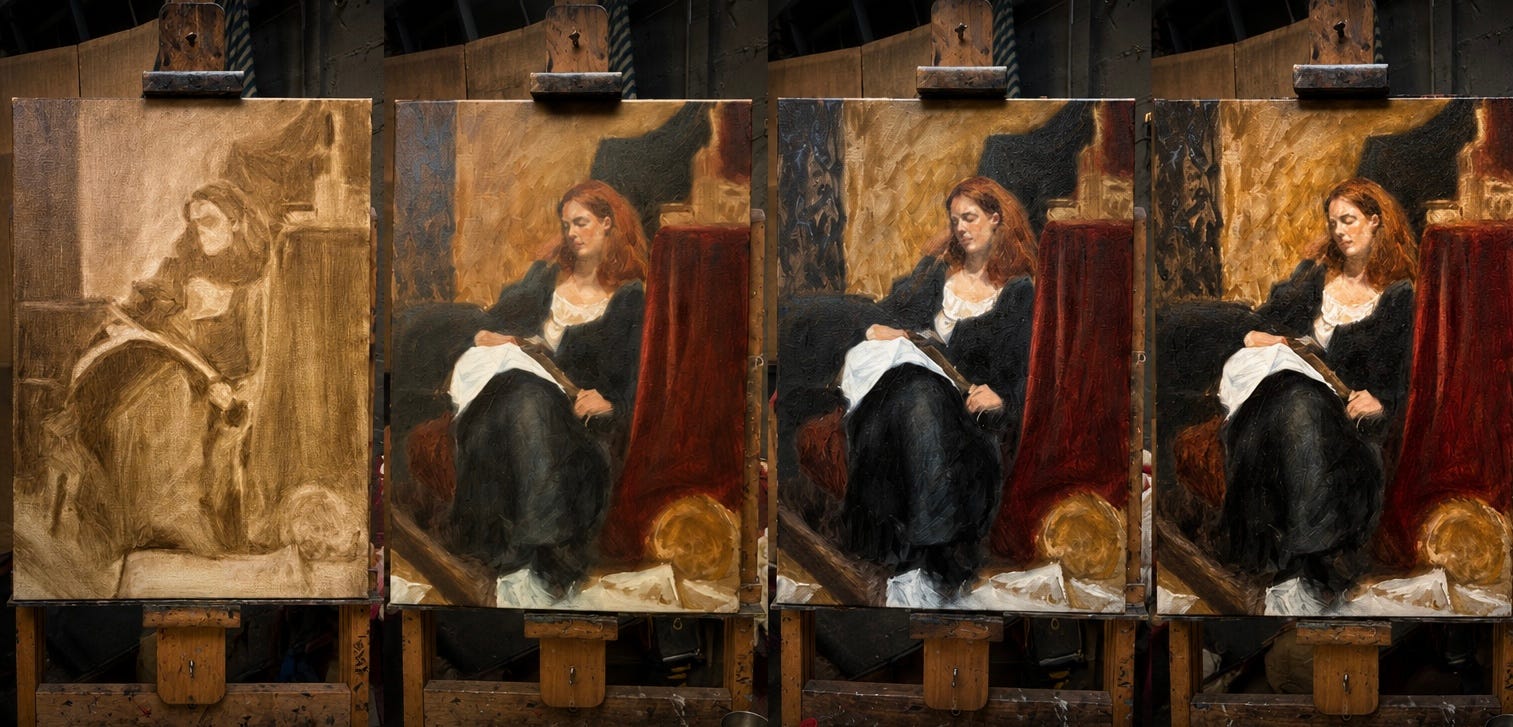
What I’ve been learning at LSFA is a particular technique: a method of working in which you begin with a careful monochrome underpainting, building the entire tonal structure of the painting in ‘grisaille’ before a single drop of colour touches the canvas. Then you build translucent layers of colour on top, building luminosity and depth over time.
The process is methodical, slow, almost meditative. The depth you can achieve is unlike anything you get from wet-on-wet painting. It is, technically, beautiful.
Here is my painting I am currently working on:
Unfortunately, though, it has, temporarily, muddled me up. Not because the technique is wrong. It isn’t! It’s the method of the Masters, for crying out loud.
But what I have noticed about learning a new process is that it doesn’t just teach you a new way of making; it momentarily dismantles the way you were already making. It gets into your instincts and starts pulling at the threads.
And when the threads come loose, everything you thought you knew about your own work starts to feel uncertain.
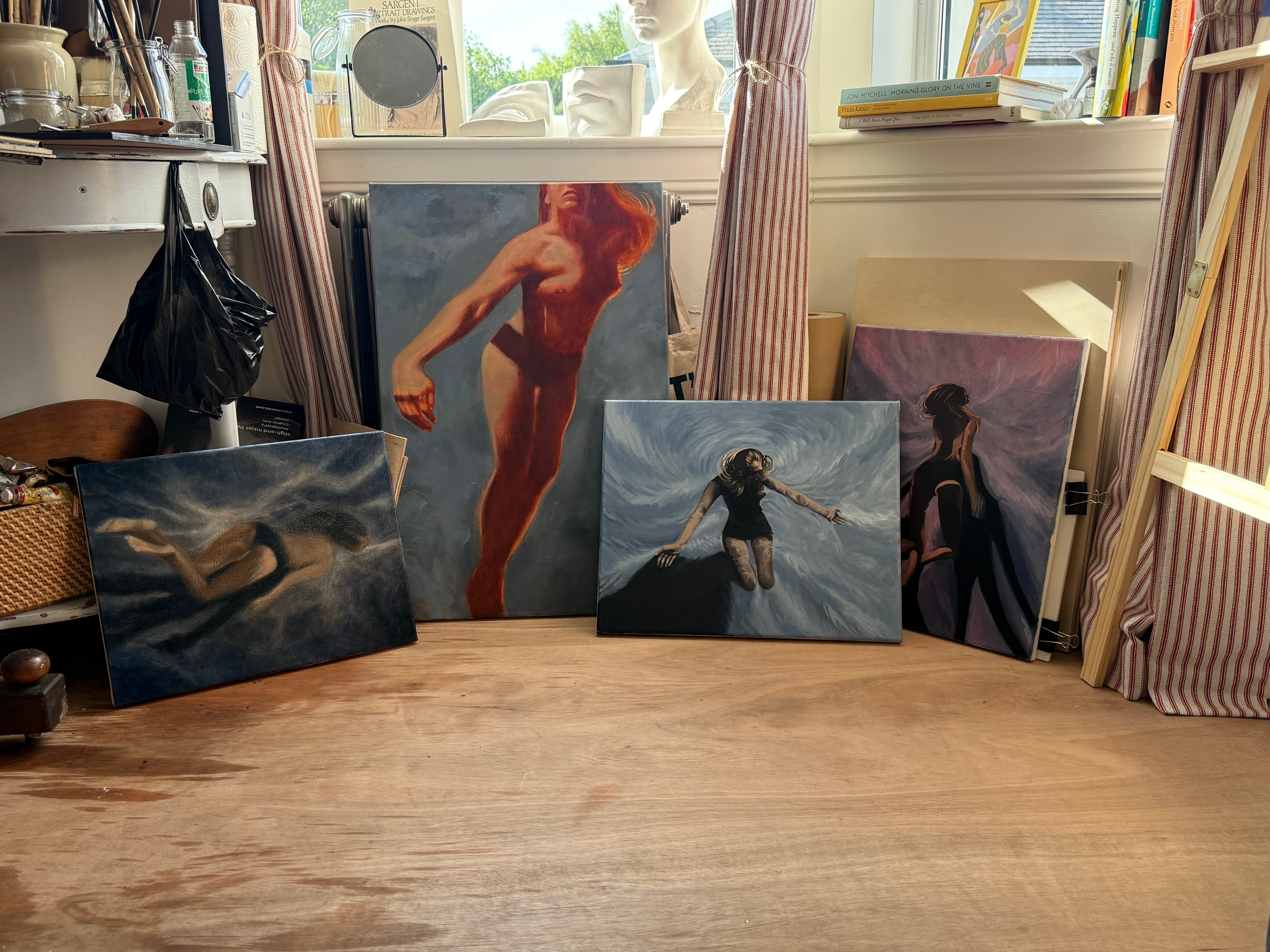
Take the swimmers; a series I’ve been building on and off for years, the work I’m probably most connected to, painted with a directness that felt right: fast decisions, physical marks, the energy of water caught in the moment. There is something in them that feels like mine; even though they aren’t ‘there yet’ in my opinion, they feel satisfying to make.
But now I’m standing in front of a new canvas, trying to apply this slower, layered, structured approach, and it’s not working for me. The swimmers don’t want to be glazed into existence. They seem to want to arrive all at once.
I’ve been trying to force them through a method that might not actually be theirs or mine, and the result is a pile of canvases I don’t want to look at, nor do I want you to look at… and a very specific kind of creative despair to boot.
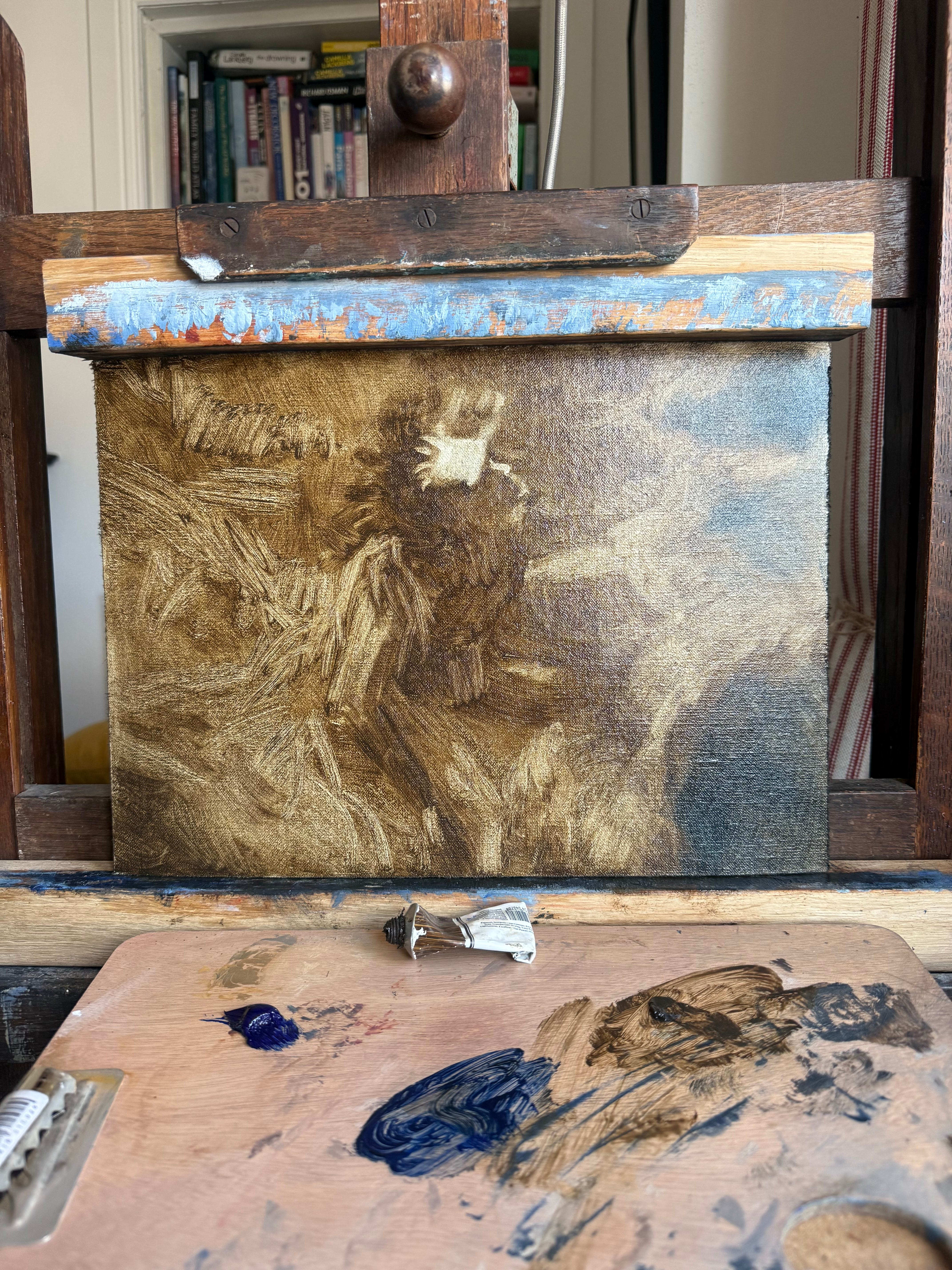
Am I getting bogged down by the process? Probably. Is the method the problem or the solution? I genuinely don’t know. But I feel confused and stuck. A feeling that is being physically compounded at the moment by the fact I am back on ‘bed rest’ again. So really, literally, stuck.
What I do know, though, is this: I want to make art that connects. That speaks. That takes you into the dark places I have been (and am in), and that shows you what I have found.
And whether that thing is painted in raw umber with a restricted palette following every principle I’ve been taught, or whether it’s scraped onto the canvas with a palette knife at two in the morning because that’s what the image needed, I’m becoming less certain that the method is the point.
Does it matter how I paint it if it’s true? Does the process matter if the thing itself speaks for me?
I’m not being dismissive of craft. Craft matters enormously, and I’m learning it with everything I have. The commute and commitment are a testament, but I’m also aware that at some point, the rules have to become so internalised that they disappear, and what’s left is just the work.
I’m just not there yet, though, guys.
And I’m not good at being in this stage.
These new tricks are not easy for this old dog, and there's an abundance of badly mixed paint colours and scraped-back canvas boards to prove it.
Recently I’ve been watching a seven-year-old learn a new skill and man, the face he makes when he can feel the gap between what he’s trying to do and what his hands are actually producing is one of the most recognisable things I’ve ever seen.
Because I’m making that face. Every day. At forty-something.
Of course, there’s a question that hovers over that child, as it does over me, and anyone attempting to learn something hard: when is the difficulty the point, and when is it a sign you’re pushing against the wrong thing? Where’s the line between this is hard and that’s okay, and this particular method of learning isn’t for you?
I don’t have a clean answer. But I’ve noticed that the question itself is useful, because it forces honesty. It makes you ask what’s actually driving the resistance: the natural friction of real learning, or something more fundamental and insightful?
In my own case, I think it’s both.
And I think I’m deep in the ugly middle of things, and the ugly middle of it all, it turns out, looks and feels a lot like failure from the inside.
Jesh, I tell you, every painting that doesn’t work feels like a referendum on whether I should be doing this at all!
Every session where the values collapse lands somewhere near a loud internal voice that says: you are wasting time you can’t afford to waste.
And these voices are worth examining, I think, because it’s not really about the painting, now is it?
Thinking, here, now, about it, I know this much to be true: I’ve built a career on productivity. Ergh, this word kills me.
But it’s true. For two decades, my worth was legible: the TV programmes, the campaigns, the column inches, the speaking engagements, the followers, the impact. I had an output. I could point at it.
I was not a person who sat around failing at things. No, sir, not me.
That version of myself was, I now understand, also a version I’d constructed out of necessity. You prove you can do things because someone, somewhere, needs to know a wheelchair user can do things. You fill every available space because empty space gets read as inability. You outproduce the judgement. You outproduce the doubt.
But now I’m in a period where I’m regularly, deliberately incompetent at something, and after twenty years of professionalism, that feels like a strange and slightly unhinged way to spend my time.
And on top of that, fucking Instagram keeps serving me feeds full of artists who appear to have it all worked out: selling out shows, painting for ten hours a day, fluent and certain in their vision. I know, intellectually, that nobody posts their worst paintings. I know the feed is not the whole truth. But fluency is deeply seductive yet threatening when you’re sitting here without words.
So I’m just over here, trying to replace the loud, productivity-obsessed voice with a softer one. A kinder one. One who understands that this sticky, messy, painful period is not the obstacle to making good work. It is probably the making of it. And in so doing, hopefully finally finding my artist voice too. My style, my language.
It seems clear I cannot get to the other side of this without going through it, and that going through it is not time wasted. It is, in fact, the only time that matters.
Some days I believe that. Some days, reader, I paint something that suggests I might actually be getting somewhere, and the relief is so enormous and so ridiculous in equal measure, I can barely contain the feeling.
But some days I don’t.
And I have a little welp and…try again.
Anyway, there is no resolution here. I told you at the start I didn’t have a neat narrative to offer, and I meant it.
What I have is the ongoing messes, the fear, the doubt, the not-knowing. The sense that I am in the middle of something I can’t see the edges of yet, and that the only way to find out what it is is to keep making. Keep failing. Keep asking the question. Keep sitting with the terrible, necessary discomfort of not yet being the artist I want to be, while making the work anyway.
After all, my life does somewhat depend on it, but this is a statement for another article.
So, anyway, hello again! This is where I am! Not arrived. Not resolved.
Somewhere in the middle.
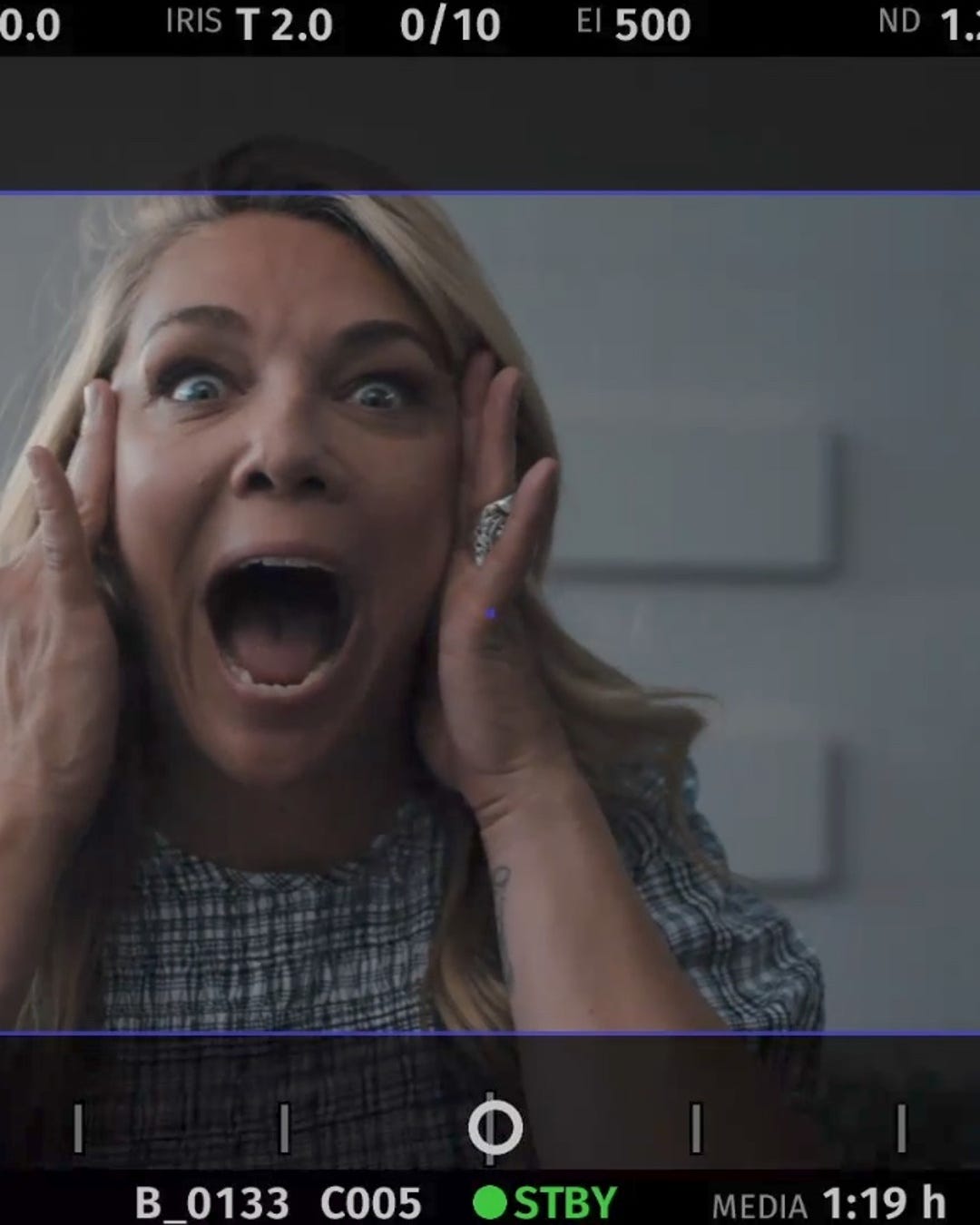
And in the meantime, you can catch me on ITVx, building flat pack furniture and screaming at my screen partner with such conviction you might be able to tell I'm not exactly acting…!

Onwards.
Sx
The Art of Sitting Still publishes sporadically. If this resonated with you, please share it, that’s how it finds the people it’s meant to find. And if you’re not subscribed yet, it would mean a lot to have you here.
I am a self taught late bloomer artist. I have felt all these feels! I do not have the training you have had or the success, but I do know one thing I have learned being in my own messy middle. When I stop enjoying the process and my excitement leaves, so does my inspiration. My drive to complete my art piece stagnates. My father has always said “Nothing happens until someone gets excited”. I have found this to be true in every aspect of my life. Good luck, I can’t wait for you to paint something out of pure excitement following only your rules.
I appreciate the messy middle truth. This is something that most of us can relate to in our own lives regardless of our art form. Beautifully shared. Thank you!